
ABOUT
Sandro Trapani
My research for my master’s degree centred around how our thoughts about behaviour and ethnography influences action, and in turn, how actions can shape thoughts. I draw inspiration from my own history, heritage, and memory to create evolved narratives. During my artistic journey I’ve come to realize the cyclical nature of these reflections, which can become obscured, at times absurd, and even obsessive. These elements become a fundamental aspect of the human experience and are deeply intertwined with the nature of art. Throughout my career as an artist, I’ve explored the never-ending quest for truth, how my own truth becomes increasingly elusive as I continue on this journey of discovery.
One of the key components of this journey is my reflection on my personal heritage. For example, my family history is full of speculation and uncertainty, particularly when it comes to my father’s ancestry. He was raised as an orphan in Florence, Italy, and there are many unanswered questions about his heritage. However, it is these unanswered questions that make my creative journey engaging and captivating to me.
Just as in archaeology, history seldom provides all the answers, but the artefacts, relics, and objects we discover capture our imaginations and allow us to wonder and explore new possibilities. New narratives are built on old information, even if that information is somewhat mysterious.
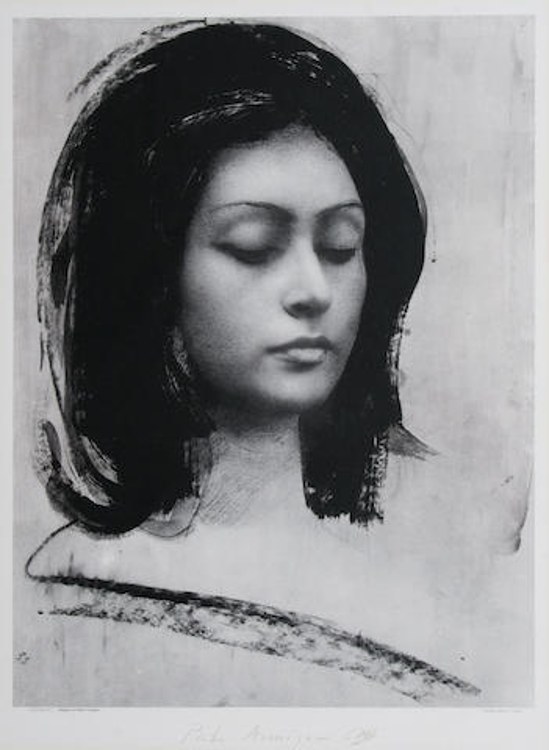
Sharmini — lithograph by Pietro Annigoni
SHARMINI
One object anchors this uncertainty: a lithograph titled Sharmini, by the Italian artist Pietro Annigoni, gifted to my father by Annigoni himself. Who she was, I never knew — and the mystery of her identity became, to me, more captivating than any answer could have been.
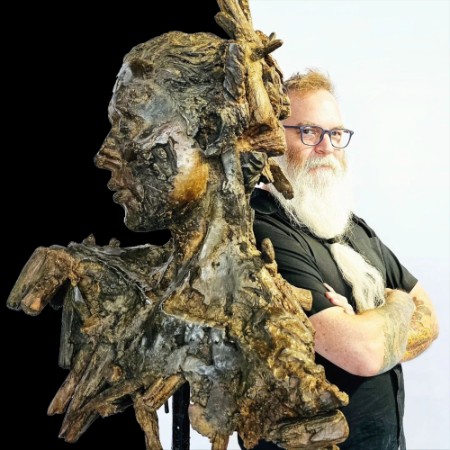
That unresolved portrait became the seed of my Dolorem series — and, more broadly, of how I work across all of my figurative pieces. None of my sculptures are modelled on one particular sitter. Each face is built from many, layered from memory, until it belongs to no one in particular.
Artist’s Statement
TERRA VETUS — 2026
In Terra Vetus, the ancient is not presented as something distant or obsolete, but as an active presence, ever changing, and embedded within our becoming. The work suggests that evolution is not a clean forward motion, but a layered accumulation in which the past persists inside the present and will do so into the future. The forms evoke a deep temporal memory — a reminder that our bodies, instincts, and myths are shaped by countless lives before us. The ancient here is not nostalgia; it is structure. It is the ground upon which consciousness, culture, and identity are built.
Central to this exploration is the recognition that life and death are inseparable. Terra Vetus proposes that life without death would be static. Death is not an ending imposed from outside life, but an internal necessity — the condition that allows renewal, adaptation, and meaning. In acknowledging mortality as fundamental rather than tragic, the sculpture reframes existence as a continuous cycle of emergence, decay, and reformation, where evolution is driven not despite death, but because of it.
TRAGODIA SERIES — ARCHIVE
Trapani reflects on a sense of beauty that is found in memories and experiences. A particular focus is given to the forgotten and the lost.
The recollections of people, places and moments can be nostalgic, even melancholic, and are at times fleeting. Memories become blurred. Remembering them accurately often leads to memory overlap. This overlap can be subtle, and might even go unnoticed, and as a result, the narratives may change, adjusted to suit the way in which we desire to preserve the memory. Over time, there is a sense of the historical but a loss of milieu. The portraits resonate with personal experiences not quite fully recalled. They become archival, reclaiming memories that recall multiple experiences all in a single sculpture.
There is a sense of sadness present in the portraits. Sorrow is suggested through the familiar-yet-less-identifiable elements introduced, such as ancient architecture, or due to the fractured, “dissolving” surfaces presented. The legitimacy of the past fades and a sense of longing comes to the fore.
The portraits Trapani creates are nonspecific, meaning that they are created from many sources and do not represent a single individual. Rather they are accumulations of many different recollections and references – a collection of beautiful but somewhat illusive memories.
Meet the Artist
In the Studio
Hanneke — progress
Medusa Grotto — progress